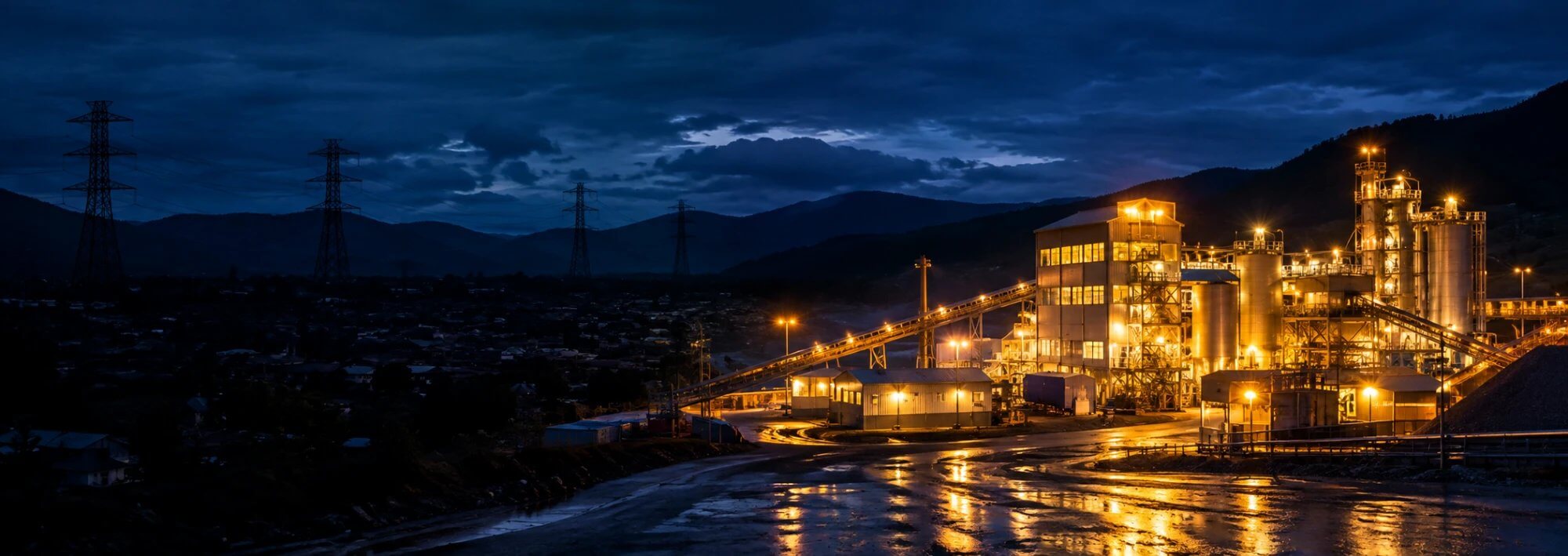

Colombia's power system reaches the end of 2026 with a double signal: demand is hitting all-time records while, at the same time, the new generation that was supposed to come online is running far behind schedule. An energy bulletin this week flagged five factors that could push the country toward rationing in 2027. For industry, this is not a distant headline: it is a signal to shield the continuity of your power supply starting now. Here is what is happening, why the gap is opening, and how to prepare.
In September 2026, energy demand reached figures never seen before: around 266.8 GWh per day and a peak power of 12,683 MW, both all-time records. Looking ahead to the 2026-2027 dry season, the system operator (XM) expects consumption to climb even higher. It is the signal of an economy consuming more energy, but also of a system approaching its limits.
The problem is that supply is not growing at the pace of demand. Of the roughly 4,475 MW of new generation expected for 2026, only about 1,027 MW had entered service by mid-September, barely 23% of what was planned. Combined with hydrological uncertainty and the limits of thermal generation, the result is a gap between the system's firm energy and demand, estimated at around 7.8% for 2026-2027.
The cause is not a single factor, but the coincidence of several. Generation projects (many of them renewables) are piling up delays in coming online; the transmission infrastructure needed to move that energy is running behind schedule; and climate variability is putting pressure on the reservoirs. UPME has pointed to years of lag in coverage and has presented an expansion plan with new transmission projects, such as the Magangue 500/110 kV substation and the new Provincia 230 kV substation, to reinforce corridors that are in critical condition today.
The conclusion is uncomfortable but clear: even if the country invests billions of dollars in transmission and generation, those projects take years. In the meantime, the system operates on an ever tighter margin, and any combination of higher consumption, low hydro inflows, and construction delays brings the risk of restrictions closer.
For an industrial plant, a data center, a hospital, or a mining operation, the lesson is direct: electrical continuity cannot be taken for granted. A scenario of restrictions or rationing hits production first, and the cost of one hour without power usually far exceeds the investment in backup. The question is no longer "will something happen?", but "how prepared is my operation if it does?".
The good news is that industry is not defenseless. Mature, proven solutions exist to reduce dependence on the system and secure critical operations, and most of them can be implemented in months, not years.
The lesson for industry. Do not wait for the risk to become reality. Assess today how critical your loads are, how much one hour without power costs you, and what combination of backup, self-generation, and efficiency shields your operation. Preparing in 2026 is far cheaper than improvising during rationing in 2027.
There are three complementary fronts for reducing the risk:
Continuity strategies for industry
Automatic transfer switchboards keep critical loads alive when the grid fails. Distributed solar generation reduces grid consumption and energy costs. And a well-specified electrical infrastructure (low-voltage panels, medium-voltage switchgear, and transformer centers) is the foundation for integrating everything safely.
The very challenge that is straining the system opens a wave of investment. Every new substation, every solar farm, every self-generation project, and every transmission reinforcement needs electrical switchgear: medium-voltage switchgear, low-voltage panels, transformer centers, and electrical rooms. For the national electrical goods industry, the situation is also an opportunity to replace imports with local manufacturing, shorter lead times, and nearby support.
Industrias Ectricol S.A.S. manufactures in Funza, Cundinamarca the solutions that enable that transition: from panels and switchgear to transformer centers and turnkey solutions for the utilities and renewable energy, industry, and mining sectors.
It is not a certainty, but a warned risk. The combination of record demand, lagging new generation (only 23% of what was expected in 2026), transmission delays, and hydro variability is tightening the system's margin for 2026-2027. If those factors coincide, the probability of restrictions rises.
Because of consumption growth (the economy, electrification, new loads such as data centers) and heat waves. In September 2026, demand hit records: around 266.8 GWh per day and 12,683 MW of peak power.
Assess how critical its loads are and combine backup (automatic transfer), self-generation (solar/DG), storage (BESS), and a reliable electrical infrastructure. Most of these solutions can be implemented in months.
Yes. It reduces dependence on the grid and energy costs, and combined with storage and automatic transfer it helps sustain critical operations when the system is under restrictions.
It is the foundation: new substations, solar farms, and self-generation projects require medium-voltage switchgear, panels, and transformer centers. Manufacturing them locally shortens lead times and reduces construction risk.
Is your operation prepared if the system is restricted?
The engineering team at Industrias Ectricol S.A.S. helps you shield the continuity of your power supply with backup, self-generation, and reliable electrical infrastructure, manufactured in Colombia.
Talk to our team See energy solutions
So far in 2026, Colombian oil production sits at its lowest level since 2014, and natural gas fell sharply. In a sector that already produces less, every barrel and every million cubic feet counts, and an...
Keep reading