

Which of the three functions actually protects your transformer? When you specify secondary switchgear for medium voltage, the letter on each module (L, P or V) decides which current the unit can interrupt: load current, short-circuit current or both. Here we explain, function by function, when to choose a line, fuse or circuit breaker module in Ormazabal secondary switchgear, CGMcosmos (24 kV) or CGM.3 (36 kV), and which data to confirm before you order it.
It means choosing, position by position, the switching device that goes inside each module. Distribution secondary switchgear is not a single box: it is built from modules joined together with the ORMALINK assembly, and each module performs a function with its own letter.
Ormazabal makes two families of fully SF6-insulated switchgear: the CGMcosmos, up to 24 kV, and the CGM.3, up to 36 kV. If you are still unsure about the voltage of your secondary switchgear, start with the guide to Ormazabal medium-voltage switchgear (in Spanish), the one on CGMcosmos 24 kV switchgear or the one on CGM3 36 kV switchgear. Here we take the next step: choosing the function.
The L function uses a three-position switch-disconnector (closed, open and earthed) and serves to receive or deliver the line. According to Ormazabal's catalog, it complies with IEC 62271-103 (switches) together with IEC 62271-102 (disconnectors and earthing switches).
Its breaking capacity for mainly active load current is 400 or 630 A, the same as its closed-loop current. The same switch-disconnector is listed with a mechanical endurance of 1000 operations class M1 (manual) or 5000 class M2 (motorized), and class E3 for making on short circuit.
The key point: it can close onto a short circuit, but it cannot break one. That is why the L function in secondary switchgear is for switching, not protection. Use it for incomers, rings and sectionalizing, and leave fault clearing to the fuse or circuit breaker that accompanies it.
The P function in secondary switchgear combines a switch-disconnector with current-limiting fuses and feeds the transformer through a 200 A feeder. The switch only operates service currents; the fuse clears the short circuit, as the Siemens technical series on switch-fuse combinations explains. The coordination between the two is governed by IEC 62271-105.
The catalog distinguishes two versions. With associated fuses, the fuse blows and is replaced. With combined fuses, the fuse striker opens the switch-disconnector on all three phases, and a shunt trip coil allows it to be opened by an external signal, such as the transformer thermostat.
There are three practical rules for this secondary switchgear:
The V function in secondary switchgear adds a vacuum circuit breaker in series with a switch-disconnector and breaks both overloads and short circuits up to its breaking capacity. It follows IEC 62271-100. According to Ormazabal's catalogs, the short-circuit breaking capacity is offered at 16, 20 or 25 kA depending on the version, in both the CGMcosmos and the CGM.3 at 36 kV; confirm the exact value in the current datasheet for your configuration.
It is controlled by a protection unit, Ormazabal's ekorRPG, which acts on time-delayed and instantaneous overcurrent in phases and neutral. Unlike a fuse, which blows when it operates, the circuit breaker can be closed again once the cause of the fault has been checked.
Ormazabal also offers the version with RAV mechanism, the circuit breaker with reclosing, with an O-0.3 s-CO-15 s-CO sequence and class M2 (10,000 mechanical operations, according to IEC 62271-100). It is an option to consider when the line is fed from overhead networks with transient faults.
Decide according to the question each position of the secondary switchgear must answer: does it only connect, does it protect a transformer, or does it protect a feeder? This table summarizes what the catalogs declare:
Function by function (Ormazabal catalogs)
In secondary switchgear, the P function is the usual solution for a distribution transformer. The fuse table in the CGM.3 datasheet covers up to 2000 kVA, and the CGMcosmos table also reaches 2000 kVA at 20 kV. For a feeder, a medium-voltage customer or a larger load, the V function is the one that offers a relay with adjustable settings.
According to Ormazabal's catalog, the CGMcosmos with a P function can be fitted with the ekorRPT protection unit (combined switch-relay), with phase and neutral overcurrent protection. It is an intermediate route when you want more protection without moving up to a circuit breaker; the configuration and its availability are confirmed when you request a quote.
Specification lesson. Before ordering secondary switchgear, write down for each position what it must interrupt: load (L), short circuit with a fuse (P) or load and fault with a relay (V). Record the voltage (24 or 36 kV), the busbar current (400 or 630 A), the short-circuit rating and the IAC classification, and the transformer power to select the fuse. With that data, the secondary switchgear is defined.
Confirm the internal arc classification of your secondary switchgear. For the CGMcosmos and the CGM.3, Ormazabal declares IAC AFL(R) classification of up to 25 kA for 1 s, but the value depends on the function, the tested kA and the gas exhaust route. On the V function, the CGMcosmos declares up to 20 kA for 1 s with upward gas exhaust. The catalogs give no different arc class for the RAV mechanism, so always confirm on the nameplate and in the current datasheet.
Every unit comes with interlocks as standard, which prevent closing the switch-disconnector and the earthing switch at the same time, plus the ekorVPIS voltage indicator and the ekorSAS alarm. The standard for the assembly is IEC 62271-200.
In Colombia, the installation must comply with RETIE, the Colombian electrical code, updated by Resolution 40284 of 2026 of the Ministry of Mines and Energy. If your project is in utilities and renewable energy, mining or Oil & Gas, Industrias Ectricol integrates the secondary switchgear from Funza, Cundinamarca. See the datasheets for the CGMcosmos and the CGM.3.
L connects and sectionalizes with a switch-disconnector, without breaking short circuits. P adds current-limiting fuses and protects the transformer. V incorporates a vacuum circuit breaker with a protection relay.
Fuses (P function) are the usual solution for distribution transformers within the manufacturer's rating table. The circuit breaker (V function) is chosen for feeders, larger loads or when a relay, settings or reclosing are needed.
No. It can close onto a short circuit (class E3 in the catalog), but it only breaks service currents. In the P function, the fuse does that job; in the V function, the circuit breaker does.
Ormazabal recommends replacing all three fuses, not just the blown one. First verify the cause of the fault and use fuses of the rating and type given in the manufacturer's table.
A plus for your schedule: we have Ormazabal CGMcosmos and CGM.3 switchgear available for immediate delivery in Colombia, which avoids the long lead times of an import. Ask us about the function and configuration of your secondary switchgear.
Have you already defined the functions of your secondary switchgear?
Confirm with our team the availability of the L, P or V configuration your project needs.
Check availability on WhatsAppView CGM.3 switchgearWhen does a 24 kV switchgear line-up stop being enough, and when do you need 36 kV? It comes down to the service voltage of your network, and in Colombia 34.5 kV circuits are common in solar farms and...
Keep reading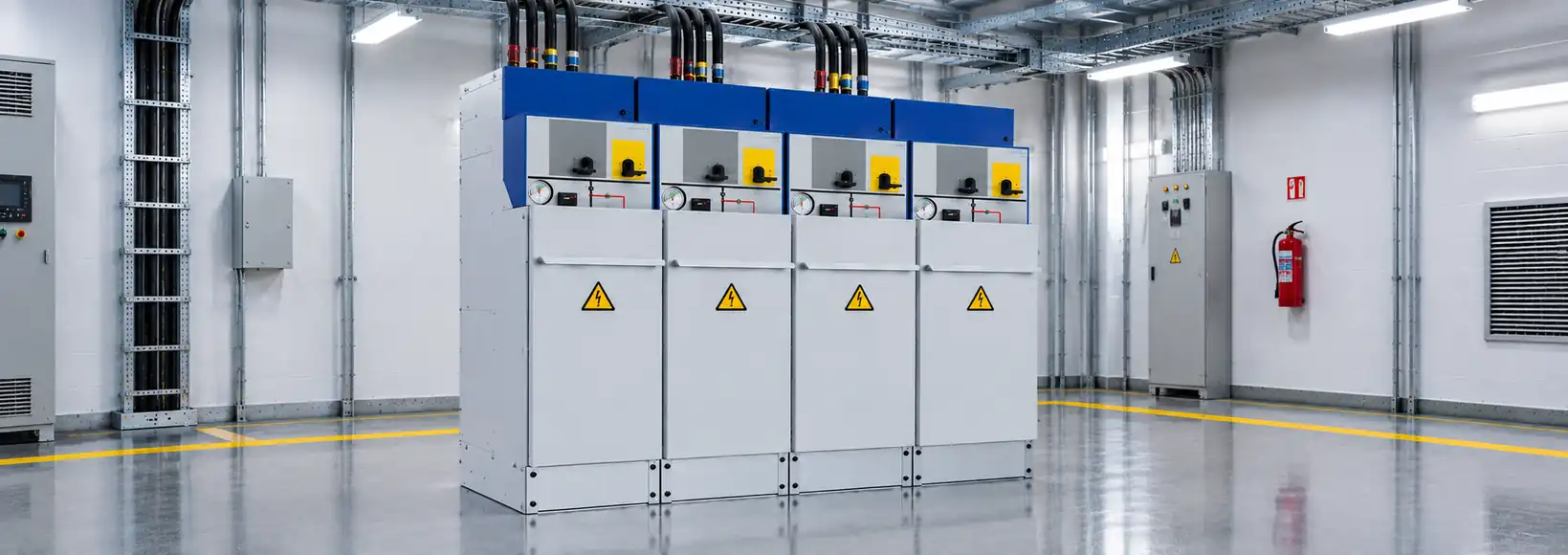
When a distribution network runs at 24 kV or below, the CGMcosmos 24 kV switchgear from Ormazabal is one of the most widely used answers for secondary switchgear: compact, gas-insulated and modular. This...
Keep reading